
M-Bus level converters from STV Electronic
Directly to the cloud
Even though energy prices have largely stabilized, saving energy remains the order of the day against the backdrop of the energy transition. The basis for Optimisation is consumption meter for electricity, water, heat and gas, which can be remotely read via the M-Bus fieldbus. In order for the communication between the meter and the network to function smoothly, so-called level converters are needed – such as those from STV Electronic GmbH, based in East Westphalia.
The power supply of large properties such as office and factory buildings or hospitals cannot be compared with that in private households. Numerous consumption meter record the demand, they provide an insight into energy saving potential, which have been an increasingly frequent topic since the energy crisis a few years ago. In order to be able to read out the meter data for water, heat, electricity and the like centrally and clearly, the appropriate infrastructure is required. In building management, the M-Bus fieldbus – short for “Meter” bus – has become particularly established. The term should by no means be understood as a unit of length, but as an English translation of the word “Zähler” (meter). Since its development in 1992, the protocol has steadily gained importance in building management. The M-Bus enables communication between the consumption meter and the central control units, making it an important component in the power supply of large properties. With the demand for more sustainability and efficiency, its importance will continue to increase in the future: According to figures from the German Environment Agency [1], German final energy consumption could fall by 15 percent by 2035 compared to 2022, and with additional efforts it could be up to 21 percent. However, this is not possible without a reliable database: For secure consumption data collection, the appropriate hardware is required in M-Bus networks, such as that offered by STV Electronic GmbH. The company’s level converters play an important role, connecting the meter data from the Sensors and the control of the Actuators in the M-Bus network via the serial and Ethernet interface.
Easy installation with M-Bus
M-Bus offers users numerous advantages in building management. Energy managers query meter data via the fieldbus in short time intervals via a simple two-wire line. The installation of the M-Bus with two “bell wires” is cost-effective and the connection is protected against polarity reversal, which simplifies installation. The bus also supplies the power for the electronics in the meter directly. The installed devices are inexpensive, and even large networks are no problem for the M-Bus. Consequently, there are few reasons to change such an established technology. However, meter with an M-Bus connection are not digitized meter with an Ethernet connection. For reliable data transmission, another device is required with the M-Bus level converters: The level converter acts as an interface between the individual Sensors and the master. It converts the voltage levels of the master signals into signals compatible with the M-Bus. This ensures that the Sensors can reliably send and receive their data. The level converters from STV Electronic connect the meter data and the control of the Actuators in the M-Bus network via the Ethernet interface and optionally via additional serial interfaces such as RS-232 or RS-485.
M-Bus level converter: Connection of control and network
The East Westphalian company offers a broad catalog of solutions for M-Bus infrastructures. Above all, the level converters of the MPW-IP series ensure a secure connection of the control with the network. The company supplies its level converters in various versions with 32 to 128 M-Bus standard loads. The MPW-IP family has the advantage that the M-Bus voltage and current are continuously displayed on the integrated website. This allows easy Monitoring of the network. The parameterisation also runs via the integrated website, which can be protected against unauthorized changes with a password. Additional PC software is therefore not necessary. The STV level converters fit into the higher-level energy management system: With the Smart Manager 4.0, companies control their energy data collection. By using established and open systems, it can be flexibly adapted to the respective Applications.
With Gateways directly into the cloud
The M-Bus is a solution at the field level, the data is recorded here and should later be brought into the cloud if possible. Finally, the consumption values of the systems can be processed and analyzed there. With Artificial Intelligence, there are even more energy saving potential, which, for example, can reduce energy consumption again in comparison with the usage data. M-Bus level converters are only one of several options for converting meter signals into Ethernet signals. Anyone looking for an interface to established building bus systems such as BACnet, KNX and Modbus can use the M-Bus Gateways MGW from STV Electronic. The Gateway collects the data from the M-Bus end devices and converts it into a Modbus format, for example. In addition, the manufacturer offers M-Bus splitters, which tap the data from the M-Bus and loop it in at any position in the infrastructure. With the splitter and Gateway, individual data from the M-Bus can also be linked separately, which enables the management of the connected meter. If you now connect cloud and Edge-based services, the measurement data from the field level comes directly to the management level without having to climb the complex automation pyramid piece by piece.
Small device width and fast commissioning
Regardless of whether it’s a level converter, splitter or Gateway: The STV devices can be used individually. They have a small device width and are characterized by easy commissioning. Devices with a serial interface do not require parameterisation, devices with an IP interface support IPv4, IPv6 and MQTT, parameterisation is carried out via a simple interface with additional diagnostic functions, and remote parameterisation is also no problem. Thanks to the protocols, the devices can communicate smoothly in older and newer networks and are therefore very future-proof. The level converters with M-Bus transmission rates from 300 to 38400 baud are also suitable for fast M-Bus devices. Together with a high and reliable M-Bus voltage of 38 volts, M-Bus runs safely and over long distances. Thanks to the connection of M-Bus hardware and the possibilities of intelligent data evaluation, energy managers now have the opportunity to reliably discover Optimisation potential and take measures to ensure that energy consumption in Germany falls even more sharply than the projections of the German Environment Agency.
Small device width and fast commissioning
Regardless of whether it’s a level converter, splitter or Gateway: The STV devices can be used individually. They have a small device width and are characterized by easy commissioning. Devices with a serial interface do not require parameterisation, devices with an IP interface support IPv4, IPv6 and MQTT, parameterisation is carried out via a simple interface with additional diagnostic functions, and remote parameterisation is also no problem. Thanks to the protocols, the devices can communicate smoothly in older and newer networks and are therefore very future-proof. The level converters with M-Bus transmission rates from 300 to 38400 baud are also suitable for fast M-Bus devices. Together with a high and reliable M-Bus voltage of 38 volts, M-Bus runs safely and over long distances. Thanks to the connection of M-Bus hardware and the possibilities of intelligent data evaluation, energy managers now have the opportunity to reliably discover Optimisation potential and take measures to ensure that energy consumption in Germany falls even more sharply than the projections of the German Environment Agency.
Author*: Dipl. Ing. Markus Hühn, Managing Director of STV Electronic
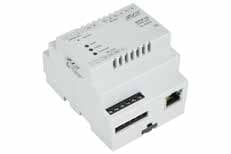
The level converters from STV Electronic connect the control with the M-Bus network.
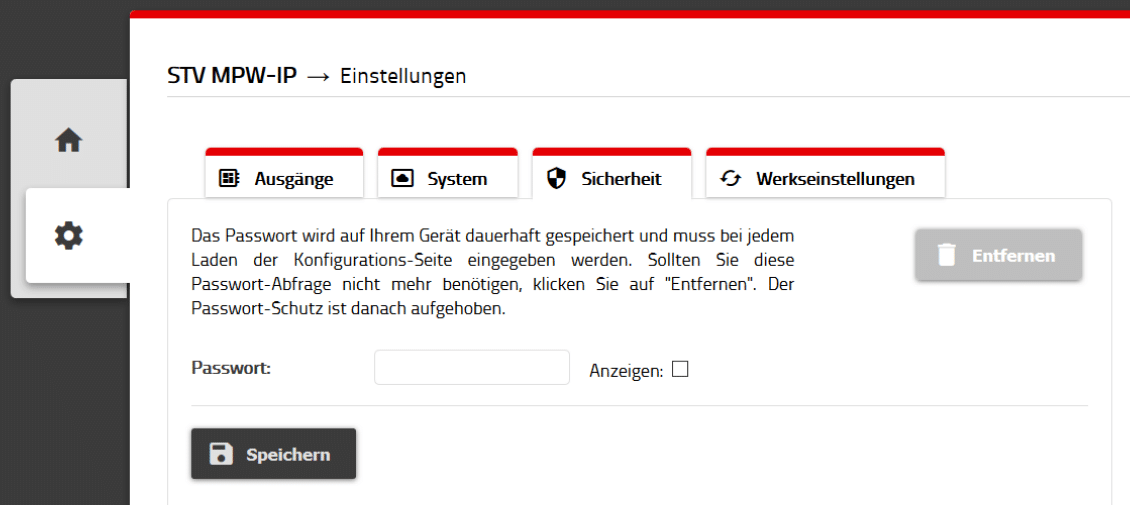
The parameterisation is easily done via the website.
Sources: [1] German Environment Agency (2023): energy saving potential. Available at: https://www.umweltbundesamt.de/themen/klima-energie/energiesparen/energieeinsparpotenziale
*The author reserves the right to publish this text on the company’s own website or in other, non-competing publications or in other languages. However, parallel second placement in a directly competitive environment is excluded. Alternative agreements are possible at any time if required